Induction Cooktop Buzzing? What's Normal, What's Not
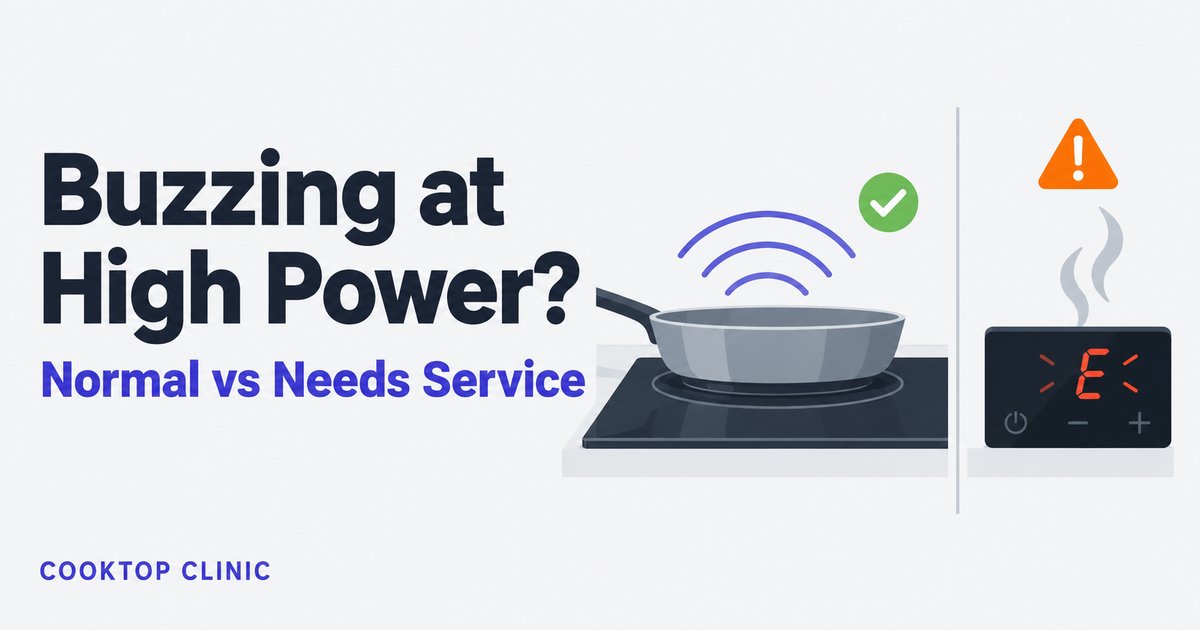
A buzz or hum from your induction cooktop at high power is normal — and much of what you hear can come from the pan itself. The energy being transferred into your cookware makes it vibrate: thin, multi-layer pans hum audibly, heavy cast iron barely whispers. Turn the power down or swap the pan and the sound changes. The noises that do deserve attention: sound that comes with an error code, a tripping breaker or a burning smell — and a new noise that no pan swap or power change explains.
GE’s owner’s manual for its Profile induction cooktops says it plainly: heavier, uniform-material pans such as enameled cast iron produce less sound than lighter multi-layered stainless steel pans or pans with bonded disks on the bottom. Same cooktop, different pan, different concert — and often that’s the whole diagnosis.
The normal sounds an induction cooktop makes
| Sound | When | What it is | Normal? |
|---|---|---|---|
| Low humming or buzzing | High power settings | Energy transferring into the cookware; manufacturer guides note it quiets or disappears when you lower the power | ✅ Normal |
| Crackling | Pans with layered bases | The bonded layers of multi-material cookware vibrating against each other; changes with the amount and type of food | ✅ Normal |
| Soft clicking | Especially at lower power settings | The electronic switches — Miele’s guide lists it among the normal sounds | ✅ Normal |
| Clicking and “zipping” | A pan smaller than the zone’s minimum size | The control “searching” for the pan, per GE — use a pan that meets the zone’s minimum size | ⚠️ Fix the pan |
| High-pitched whistle or intermittent hum | Two neighboring zones running at certain settings | Their magnetic fields interacting, per GE; raising or lowering the power on one or both zones reduces or stops it | ✅ Normal |
| Fan whirring | During and after cooking | The cooling fan protecting the electronics — it keeps running after you switch off, and that’s by design | ✅ Normal |
Manufacturer documentation backs each of these — KitchenAid’s user guide, for instance, describes the high-power hum as the energy transmitted to the cookware (quieting as power drops) and the crackle as cookware built from different materials vibrating at the joints. This isn’t your unit malfunctioning; it’s the technology being audible.
Why does the pan make the noise?
Induction works by pushing a rapidly alternating magnetic field into the magnetic base of your pan. That field doesn’t just heat the metal — it makes it vibrate slightly. Physicists call the underlying effect magnetostriction (general physics — the cooktop manuals simply call it normal cookware noise); your ears call it a hum.
How loudly a pan sings depends on its build:
- Loudest: lighter multi-layer pans, pans with a bonded disk on the bottom, and pans with a base that isn’t flat — GE lists flatness as a factor.
- Quietest: heavy, uniform-material pans — GE’s example is enameled cast iron. Pans that completely cover the zone’s ring are quieter too.
That ranking comes straight from GE’s owner’s manual, which also lists the size of the pan and how full it is as factors. It also surprises people in one specific way: folks expect big rough cast iron to be the noisy one. It’s the opposite — the flimsy pan is the loud pan.
The 30-second test before you call anyone
Worried the buzz means something’s failing? Isolate the variable:
- Note the zone, the power level, and the sound.
- Swap in a different pan — ideally a heavy, flat-bottomed one. Same zone, same power.
- Listen.
If the sound changes or disappears, the cookware is the main variable — that points to normal pan noise rather than a fault, and your options are living with the hum, dropping the power a notch, or letting this be the excuse for that nice heavy skillet. The test isn’t a manufacturer procedure, and a pan swap alone can’t rule out every fault. If an unusual sound persists identically with completely different pans, keep reading.
When the noise IS a problem
Four situations break the “it’s normal” pattern:
- A high-pitched whine that seems to come from an empty zone. Rule out the neighbors first: GE documents a normal high-pitched whistle when two adjacent zones run together, and a zone with no pan is designed to detect that and switch itself off (KitchenAid’s guide: within 30 seconds). If the tone persists with nothing else running, owners report it as worth a technician’s look — no manual lists it as a fault sign, so treat it as a question for service, not a diagnosis.
- A new noise with your same old cookware. Rule out the usual variables first — GE notes that how full the pan is, cold contents (the buzz fades as the pan heats) and neighboring zones all change the sound. If the new sound persists across all of that, mention it to a technician.
- Noise plus symptoms. A buzz accompanied by an error code on the display (F-codes on KitchenAid, F47/Er47 on GE Profile), zones cutting out, or a breaker tripping isn’t a noise question anymore — follow the code or the electrical symptom.
- Anything with a burning smell, sparking, or cracked glass. Stop using the cooktop, switch it off at the circuit breaker, and call for service. Cracked glass is a shock risk in the manufacturers’ own words — KitchenAid’s guide says not to cook on a broken cooktop and to contact a qualified technician immediately. That’s true with or without sound effects.
None of this involves opening the unit — it runs on a 208/240-volt circuit, and everything behind the glass is technician territory. Sound diagnosis is done entirely from the cooking side. If a technician is warranted, tell them which zone, at what power, with which pan, and whether the sound happens with nothing else running; that sentence does half their triage.
FAQ
Does the buzzing mean my cooktop is wearing out? No. GE’s troubleshooting chart lists buzzing, whistling and humming as normal sounds, and the high-power hum is the energy transfer itself, not a sign of wear. What deserves a closer look is a new sound that the pan, the power level and the neighboring zones don’t explain.
Is cast iron noisier on induction? Usually the opposite. Heavy cast iron, bare or enameled, is among the quietest; lighter multi-layer pans are typically the loud ones.
What is coil whine? A colloquial name for a high-pitched tone under load. On induction, a high-pitched whistle can be normal: GE documents one when two neighboring zones run at certain settings, and changing either zone’s power level reduces or stops it. A persistent tone with nothing else running is worth mentioning to a technician.
Can I make it quieter? Three levers: lower the power (GE: when the power level goes down, so does the sound), use heavier flat-bottomed cookware, and use a pan that sits centered and covers the zone’s ring. Don’t expect silence at full power — some sound at high settings is normal.

Erin Cole — Erin Cole is the pen name of Cooktop Clinic’s editor. I’m not an electrician or an appliance technician, and I don’t sell cooktops or cookware. Every guide here starts from the manufacturers’ owner’s, installation, and service documents, is cross-checked against what owners consistently report, and says which is which — plus a clear line on when a fix is yours to do and when it’s a job for a licensed electrician.