Induction Cooktop Fan Keeps Running After Off? Normal
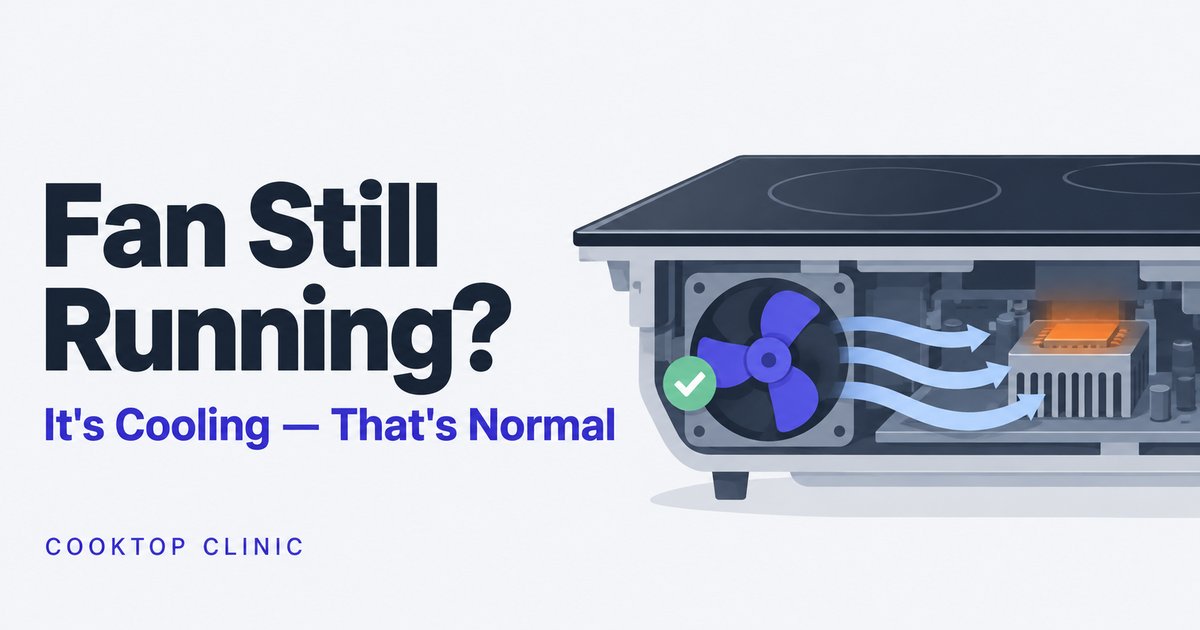
The fan you hear after switching off your induction cooktop is normal. It’s cooling the power electronics under the glass, and it stops on its own once the temperature drops — Miele’s manual says outright that this “is not a fault.” The manuals describe the fan as automatic, so there’s nothing for you to switch off. The times it deserves your attention: it keeps running long after the glass has cooled, it starts up with the cooktop cold and unused, or it develops a metallic grinding rattle.
If that whirring sent you back to check you hadn’t left a burner on, you’re in good company: “the fan won’t shut off” is a common question from induction owners, and many assume it means something is broken. It isn’t — the cooktop is just doing its after-work routine.
Why does the fan keep running after I turn the cooktop off?
An induction cooktop is, at heart, a box of power electronics driving copper coils. Those electronics generate real heat while you cook — and they’re heat-sensitive themselves, which is a little ironic for a cooking appliance. So the cooktop carries its own cooling fan, and it runs at whatever speed the internal temperature calls for.
Manufacturer guides say this plainly — KitchenAid’s, for example, notes that the fan runs at various speeds according to the temperature it detects and may continue running after the cooktop has been switched off if that temperature is still high; Miele’s says it runs until the appliance has sufficiently cooled, then turns off automatically. Switching off the zones stops the cooking instantly; the heat already inside the chassis takes longer to clear. The fan works that backlog, then shuts itself down.
There’s a second heat source people forget: the pan. GE’s manual notes the glass can be hot from residual heat transferred from the cookware — so it stands to reason that a big pot of stew left on the cooktop keeps things warm below deck longer than a small skillet you whisked away to the sink.
How long is normal?
There’s no universal number — none of the manuals give one, and it varies by model and by how hard you just ran it. The documented answer is simply “until the electronics have cooled.” What stretches it:
- A long session at high power (searing, canning, a rolling boil for pasta night with guests) — Miele’s guide says that’s what brings the fan on.
- Blocked airflow — more on that below, because it’s the one item on this list you control.
- Plausibly, more heat overall — several zones at once, or a hot kitchen — though the manuals don’t list those.
If the whirring is still going long after the glass has cooled and the kitchen has moved on to dishes, it’s worth a closer look.
The 3 signs the fan is telling you something
- It keeps running long after the glass has cooled. Rule out blocked ventilation first — GE’s service guide pairs overheating with checking the fan and the vents. If the airflow is clear, it’s worth a service call.
- It starts with the cooktop cold and unused. A fan that spins up on its own, no cooking anywhere in recent memory, points to the electronics misbehaving. If your cooktop is also switching itself on or off, switch it off at the circuit breaker, leave it off and call service — Bosch’s guide gives exactly that instruction for a cooktop that may switch on unintentionally. If it’s ignoring touches, mention both symptoms in the same service call; they may be one problem.
- It sounds wrong. A healthy fan is a smooth whir. Grinding, rattling, or a rhythmic tick could mean the fan is wearing out or something is in the airstream — a technician’s diagnosis. Fans are replaceable parts, but inside the unit (GE’s service guide has the heat shield removed to reach them), so that’s a technician’s job, not yours.
And a related note: when the electronics get too hot, some cooktops shut the panel down to protect themselves — on current KitchenAid induction cooktops that even has its own code, F0EA, in the FxEx code family. Persistent heat problems are worth solving before they reach that point.
The one thing you can actually do: keep the vents clear
The cooktop breathes. Depending on the model, it draws cooling air from underneath or through a vent cutout at the back of the cabinet — your installation instructions show where — and those paths are easy to choke without noticing:
- Don’t seal off the space under the cooktop with tightly packed drawers or a custom cutting-board shelf pressed against the underside.
- Keep towels and anything flammable or plastic off and away from the cooktop (KitchenAid’s guide: never on or near the surface), and don’t let anything block the ventilation openings your installation uses.
- If the cooktop sits over a drawer, keep the clearance your installation instructions specify — KitchenAid’s calls for 5-1/8 inches from the countertop to the top of the drawer, and Frigidaire and Miele don’t recommend a drawer underneath at all.
Blocked ventilation can make the electronics run hotter — GE’s service guide links a lack of cooling air to overheating — and it’s the cheapest fix on this entire page. That’s the whole intervention, by the way. The fan lives inside the appliance, and this is a no-tools zone: nothing here involves opening the unit. If you smell burning, see sparking or spot cracked glass, stop using the cooktop, switch it off at the breaker, and call for service rather than investigating with a screwdriver.
FAQ
Can I turn the fan off manually? Not that the manuals describe — they present it as automatic, running at speeds set by the temperature it detects and stopping on its own once the electronics have cooled. It’s there to protect the electronics you paid for.
Does the fan use much electricity? No manual gives a figure, but it’s a small internal fan — GE’s service guide lists 12-volt DC fan motors on the models it covers — not a heating element. The noise is the bigger cost.
Why does it run after some meals and not others? Short, low-power cooking may never heat the internals enough to need an after-run — GE’s service guide notes the fan may not run at all at low settings. Long high-power sessions are what bring it on, per Miele’s guide. Both are normal.
My fan got louder over the months. Replace the cooktop? No — but a fan that’s grown steadily louder or rattly is worth a technician’s look, and fans are replaceable parts. Mention how it’s changed over time.

Erin Cole — Erin Cole is the pen name of Cooktop Clinic’s editor. I’m not an electrician or an appliance technician, and I don’t sell cooktops or cookware. Every guide here starts from the manufacturers’ owner’s, installation, and service documents, is cross-checked against what owners consistently report, and says which is which — plus a clear line on when a fix is yours to do and when it’s a job for a licensed electrician.