GE Profile Cooktop F47 Error: Meaning + How to Reset
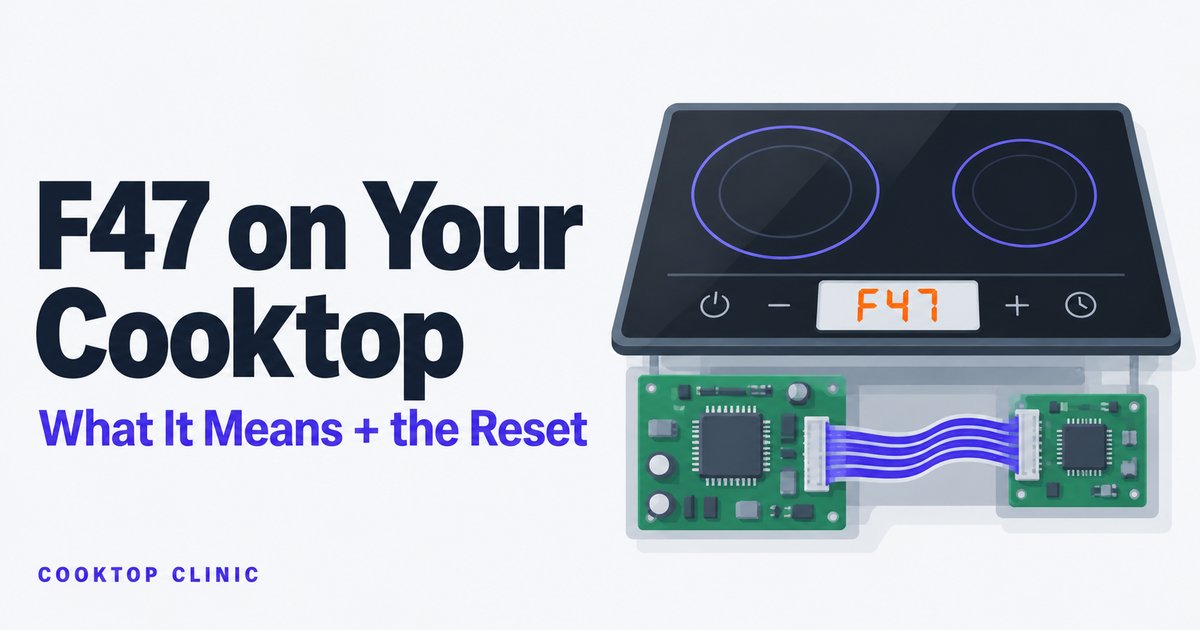
On the GE Profile and Monogram induction cooktops covered by GE’s 2008 service guide (Pub 31-9164), the “47” error — Er47 — is a communication failure in the ribbon cable between the touch board and the filter board. Your safe first move: cut power at the breaker for 30 seconds, then restore it. If the code stays gone, it was likely a glitch; if it comes back, the next steps are a technician’s job. Current GE Profile models don’t publish code meanings: record the code and call for service.
Which “F47” is your cooktop actually showing?
Here’s the wrinkle that trips people up in forums: GE’s induction documentation uses two different code families, neither of them literally “F47,” and the owner typing “F47” into a search bar may be looking at either one.
- Diagnostic codes (
Er__) — on the cooktops GE’s April 2008 service guide covers (Pub 31-9164: Profile PHP900 30”, PHP960 36”, and Monogram ZHU30/ZHU36 built-in induction cooktops), the touch board stores these and a technician reads them in a diagnostic mode. In everyday use, the owner-facing alert for a hardware fault on these models is a lone flashing “E”. The communication code in this family is Er47. - Service-mode codes (
FA__) — a GE technical service manual for one of its induction ranges (the Profile PHB925, built around a Main Logic Board) uses FA codes, and the “47” in that family is FA47.
So before anything else, look at the display again. A lone flashing “E” is GE’s own “hardware error — call for service” alert. If a technician’s readout says Er47, you’re in family one; if it says FA47, you’re in family two, on a range. Both definitions describe one board not hearing another, but they come from different products and point at different connections, which matters when someone opens the unit. And on current GE Profile cooktops (the PHP7030/9030 family), the owner’s manual doesn’t publish meanings at all: record the code and call for service.
What does Er47 mean?
Per GE’s service documentation (Pub 31-9164): Er47 indicates bad communication in the ribbon cable between the touch board and the filter board. In plain English: the panel you touch and the board that manages power aren’t hearing each other, so the cooktop stops rather than guess.
Don’t lump Er39 in with it, though. The same document lists Er39, like Er20 and Er22, as an internal electronic failure on the touch board itself, with a touch-board replacement as the service fix. Your first move is the same (a breaker reset); the part the technician looks at is different.
GE’s service steps for Er47 are to visually check the ribbon cable connection between the two boards and to replace the filter board. Notice what both of those have in common: they happen inside the appliance. That’s the line. The reset below is yours; the ribbon cable is not.
And FA47?
GE’s technical service manual for the Profile PHB925 induction range defines FA47 as the enable signal failing to reach from the Main Logic Board to the Cooktop Bridge Board — again, one board trying to talk to another and getting silence. The documented service path runs from checking the harness connection to replacing the bridge board or the Main Logic Board itself. That’s range documentation: don’t assume it applies to a built-in cooktop.
If that sounds like exactly the kind of sentence you don’t want to act on personally: correct. It’s here so you understand what the technician will be checking, not so you can beat them to it.
The GE 2008 service-guide code table
For orientation — these are the codes GE’s service guide (Pub 31-9164, April 2008) lists for the built-in induction cooktops it covers. The E-c, E-o, lone “E” and flashing “F” alerts are the ones GE describes for owners in everyday use; the Er and numbered E codes sit in the guide’s diagnostics section, for the technician:
| Code | What GE’s documentation says | First move |
|---|---|---|
| Er47 | Communication failure in the ribbon cable between touch board and filter board | Breaker reset; if it returns → technician |
| Er39 / Er20 / Er22 | Internal electronic failure on the touch board | Breaker reset; if it returns → technician (touch-board replacement) |
| Er31 | One filter board not configured to work with the other (36-inch models only) | Technician (configuration/board work) |
| Ec | Keypad detects continuous activation — water, spills, or something resting on the panel | With the zones off and the glass cool (a wet cloth on hot glass can cause steam burns, GE warns), clean and dry the panel, then touch ON/OFF |
| Eo | Element or electronics overheated | Let it cool 30–45 minutes; check that the air intake isn’t blocked |
| E5 | Internal failure on the filter board — GE’s first check is the supply voltage reaching the home (above 208 V) | Breaker reset; if it returns → technician (who may need an electrician to check the supply) |
| E6 | Internal failure on the generator board | Breaker reset; if it returns → technician |
| E7 | Unknown error in the system | Breaker reset; if it returns → technician |
| E9 | Temperature rising too fast, or an open sensor | Breaker reset; if it returns → technician |
| “E” alone | Hardware error | Service call |
| Flashing “F” | Pan removed or off-center during cooking | Put the pan back centered within ~30 seconds or the element shuts off |
Third-party repair guides (Sears’ parts documentation among them) publish a similar table with likely replacement parts per code — filter board, generator board, touch board — which lines up with GE’s own list, but treat part predictions from any list as a starting hypothesis for the tech, not a shopping list for you.
First, the safe reset: breaker off, 30 seconds
This is the one step that’s fully yours, and it resolves the “the electronics hiccupped” cases:
- Go to your electrical panel and switch off the breaker that feeds the cooktop. (GE’s installation instructions require its induction cooktops to be hardwired — there’s no plug to pull.)
- Wait 30 seconds — the interval GE’s service guide uses before any parts are replaced.
- Switch the breaker back on and give the cooktop a moment to wake up.
- Try a burner.
If the code is gone and stays gone through a normal cooking session, you’re done — a momentary communication glitch got cleared, which is precisely what a power cycle is for. (If flipping that breaker is a regular event in your kitchen for other reasons, that’s a different problem worth its own diagnosis — see why an induction cooktop trips the breaker.)
The code came back. Now what?
A code that survives the reset is past the point of owner troubleshooting. That’s the honest boundary on this one. Er47 lives in a ribbon cable and two circuit boards behind glass and sheet metal, in an appliance that runs on a 208/240-volt circuit. Inspecting or reseating that cable, testing boards, and replacing them is technician work — not because it demands genius, but because it demands opening a high-voltage appliance, and that is not an owner job. GE’s service guide itself is written for people with electrical, electronic and mechanical training, and tells them to disconnect power before servicing.
GE’s service documentation does describe a diagnostic mode technicians use to read codes on these models — worth knowing it exists, because it’s how a tech confirms the fault quickly. What happens after that readout is board-level work, and it’s theirs.
Stop immediately — switch the cooktop off at the breaker, leave it off, and call for service (no reset, no retry) — if you notice a burning smell, sparking, or cracked glass. Those aren’t glitches to power-cycle away. GE’s owner’s manual is explicit about cracked glass: don’t cook on a broken cooktop — it’s a shock risk — and contact a qualified technician immediately.
Why did only some burners stop working?
A pattern that comes up often in owner forums: “two burners on one side stopped working” or “left side is dead.” Many owners report this half-cooktop failure, and on the cooktops covered by GE’s 2008 service guide it isn’t just a forum theory: the guide documents that the left and right cooking zones are powered by separate, independent induction generators — one generator board per side, each running two elements. So a fault on one side’s electronics can take that side down while the other cooks on. Current GE models also divide the cooktop into cooking zones that share power, but their owner’s manual doesn’t describe the boards inside, so don’t assume the same layout. Either way, note exactly which zones died. It’s useful evidence.
What to tell the technician
A 30-second script that can save you a second visit:
- The exact code as displayed — a lone flashing “E”, or the exact letters and digits you saw — not just “an F47 thing.”
- Which zones are affected — all of them, or one side, or one burner.
- Whether the breaker reset clears it — and for how long. “Clears it for a day, then it’s back” is a very different data point from “comes back instantly.”
- Your model number (on the underside or in your paperwork) so they arrive with the right boards on the truck.
FAQ
Can I fix an F47 / Er47 error myself? The reset, yes — breaker off 30 seconds, back on. Anything beyond that, no: the documented causes live in a ribbon cable and control boards inside a 208/240 V appliance, and GE’s service steps for them (inspect connections, replace boards) are technician territory.
Does the reset always clear the code? It clears a transient glitch. If Er47 returns after a proper 30-second power-down, GE’s documented next steps are all internal — which is your signal to stop resetting and book the service call.
Is it the touch board, the filter board, or the cable? For Er47, GE’s service guide lists two steps: visually check the ribbon cable connection between the touch board and the filter board, then replace the filter board. Which one fixes it is exactly what the tech’s diagnosis is for; there’s no owner-side test that separates them.
Is this the same as KitchenAid’s F1E1 or F6E1? No — different brand, different code scheme, and KitchenAid’s user guide doesn’t publish what F1E1 or F6E1 mean; it only gives a power reset and says to call service if the code persists. That shared first step — power-cycle, then call if it comes back — is the only real overlap. If there’s a KitchenAid in your life, here’s the FxEx decoder.

Erin Cole — Erin Cole is the pen name of Cooktop Clinic’s editor. I’m not an electrician or an appliance technician, and I don’t sell cooktops or cookware. Every guide here starts from the manufacturers’ owner’s, installation, and service documents, is cross-checked against what owners consistently report, and says which is which — plus a clear line on when a fix is yours to do and when it’s a job for a licensed electrician.