Induction Cooktop Tripping the Breaker? Here's Why
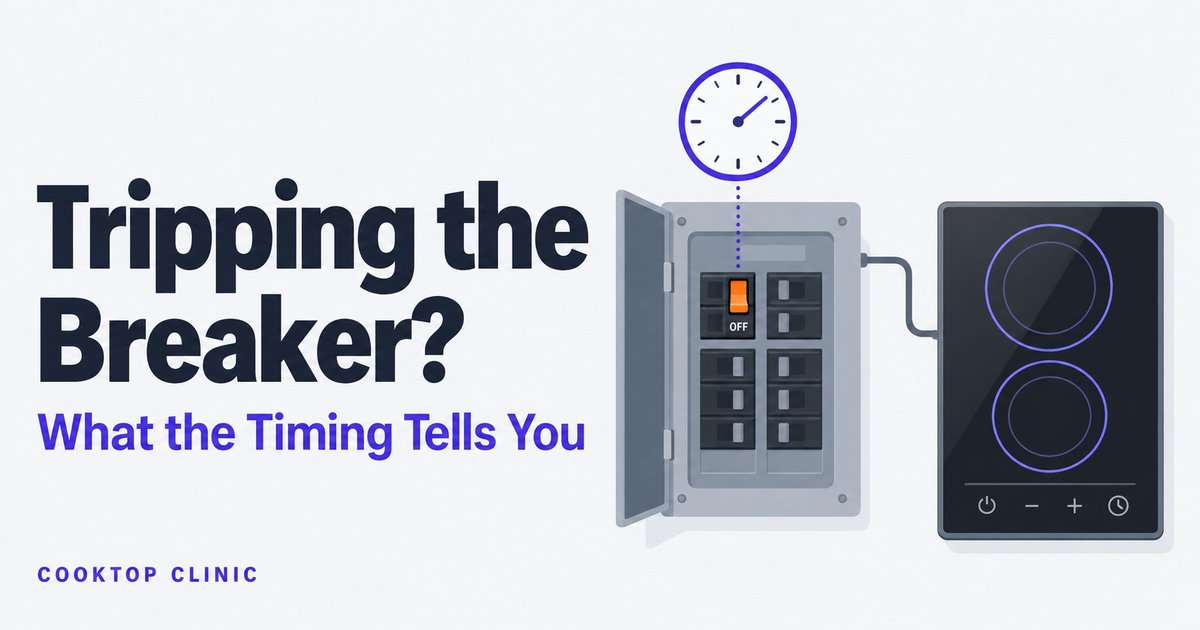
Take a breath: a tripping breaker doesn’t automatically mean a dead cooktop. A breaker that keeps tripping often points to the circuit rather than the cooktop — and when it trips is a useful clue for your electrician. Trips the instant you turn it on: possible short or wiring fault — stop and call an electrician. Trips only on Power Boost or with several zones running: possibly an undersized or shared circuit. Trips minutes in, or seemingly at random: possibly a GFCI nuisance trip. And if you ever smell burning or see a spark, stop using it now.
Often the appliance is fine and the circuit is the story — but a few warning signs mean you stop immediately, so let’s get those out of the way first.
First, the safety call: when to stop and call an electrician
I’m not an electrician, and nothing in this guide involves opening the cooktop, touching wiring, or working inside your breaker panel — a cooktop runs on a 208/240-volt circuit. The job here is to diagnose the symptom well enough to describe it — the actual electrical work belongs to a licensed electrician.
Stop using the cooktop — and do not reset the breaker again — if you notice any of these:
- A burning or hot-plastic smell from the cooktop or the breaker panel
- Sparking, arcing, or a popping sound when it trips
- Cracked glass anywhere on the cooktop
- A breaker that feels unusually hot to the touch
Any one of these means the trip may be doing exactly what it’s designed to do: interrupting a real fault. Leave the breaker off and get help: a licensed electrician for the circuit and panel, the manufacturer’s authorized service for the cooktop itself. Cracked glass is a shock risk in the manufacturers’ own words — Bosch’s guide says to switch the appliance off at the circuit breaker. Resetting into a genuine fault, over and over, is how electrical fires start.
None of those? Good — then you may be looking at one of three situations, and the timing is a useful clue.
When does it trip? The fastest clue you have
Before anything else, pin down the timing. Different causes tend to show different patterns:
| When it trips | Possible cause | What to do |
|---|---|---|
| Instantly, every time you turn it on (or the moment you reset the breaker) | Internal short or a wiring/installation fault | Stop resetting. Licensed electrician or service tech |
| Only on Power Boost, or with two or more zones on high | Overloaded circuit — undersized or shared | Check the installation instructions vs. the breaker label; electrician evaluates the circuit |
| A few minutes in, at random, or even after you turn it off | GFCI nuisance trip | Check what type of breaker you have — see the GFCI guide |
| Once in a blue moon, then fine for weeks | Borderline load or occasional nuisance trip | Log the pattern (zones, power levels, time) and mention it to an electrician |
Treat that table as a starting clue, not a diagnosis — an instant trip, for example, can come from the installation, not just from the cooktop. The rest of this article walks through the three causes so you know what you’re describing when you make the call.
Cause 1: the circuit is undersized — or shared with the oven
This is the classic dinnertime trip. An induction cooktop pulls serious current when several zones run hard, and the circuit behind the wall has to be sized for it.
Two numbers need to agree:
- What the cooktop requires. Your model’s installation instructions state it, and the rating plate (on a label on the underside of the unit, per several manufacturers) carries the electrical specs. On GE, for example, the plate gives the kW rating and the installation instructions convert that into a circuit size. Don’t trust a generic number from the internet: it varies by brand, model and width.
- What the circuit provides. The number printed on the breaker handle in your panel — often 30, 40 or 50 on a cooktop circuit (GE’s sizing chart runs from 20 to 50 amps, depending on the cooktop’s kW rating).
If the cooktop’s installation instructions ask for a 50-amp circuit and the breaker says 40, the circuit doesn’t meet the appliance’s requirement — and a heavy load (Power Boost, two big pots, a wok sear) is the likeliest moment for it to trip. That’s not the breaker misbehaving; that’s the breaker doing its job on a circuit that’s too small for the appliance.
Power Boost deserves special mention. It deliberately drives a zone beyond its normal rating for a short burst, which is wonderful for pasta water and merciless on a marginal circuit. Many owners find their cooktop only trips the breaker on Power Boost, or only with several zones running high at once — and that pattern points toward circuit capacity rather than a defect. (On some models, two zones on the same side share one generator and automatically limit each other, so the total load across the cooktop is what matters.)
The other common version: the cooktop shares a circuit with the wall oven. Some older installations fed one range circuit, and when a separate cooktop and oven replaced the old range, both got landed on it. Each appliance is fine alone; Thanksgiving is when you find out. Owners report exactly this pattern — cooktop fine, oven fine, both together trips — and it’s a question worth settling with your electrician, because many cooktop installation instructions call for an individual, separate or dedicated circuit (Bosch ties it to what the electrical code requires).
The fix is electrician territory: confirming the wire, upgrading the circuit, or splitting the cooktop and oven onto their own circuits. What the fix is not is you swapping in a bigger breaker on the existing wire — whether any breaker change is safe depends on the wire, its insulation rating, the appliance and the code, and that call is the electrician’s. More on that in the FAQ.
Cause 2: a GFCI nuisance trip
If your trips don’t correlate with heavy loads — the cooktop trips the breaker when you turn it on at low power, or minutes after you finish, or at random — and your breaker has a TEST button on it, you’re probably not overloaded at all. You may be looking at a GFCI nuisance trip: the commonly cited explanation is that induction electronics leak tiny amounts of high-frequency current that a sensitive breaker misreads as a fault. It’s common enough that appliance makers like Wolf document it and at least one state changed its electrical code over it.
That’s a different diagnosis with a different fix, and it deserves its own article: Induction Cooktop Tripping the GFCI? Why + the Fix. If your breaker has a test button, go read that one — it’s probably your story.
Cause 3: an internal short inside the cooktop
The rare one, and the one the safety box above exists for. Induction cooktops contain high-power switching electronics (you’ll see repair forums talk about IGBTs — the power transistors — and the coils they drive). When one of those genuinely fails shorted, repair forums describe a typical pattern:
- The breaker trips instantly, every single time — at power-on or the moment you reset it
- Sometimes with a pop, a spark, or a burnt-electronics smell
- Sometimes after a specific event: a boil-over that got into the vents, a power surge, or a zone that had been buzzing abnormally beforehand
An instant trip isn’t proof of a shorted cooktop, though: the installation can do it too. GE’s instructions for one of its ranges, for example, warn that a ground strap left in place on a GFCI-protected circuit can make the breaker trip instantly after powering on. Either way, it’s a service call — an electrician or appliance technician, not a screwdriver. There is no owner-serviceable part inside an induction cooktop — KitchenAid’s guide, for one, refers all servicing beyond what the manual covers to a qualified technician — and power electronics are no place for an owner to go poking, even with the breaker off. Don’t open it.
What you can check without opening anything
Everything below is observation — no tools, no panel covers, no wiring.
- Reset once, deliberately. One reset after a trip is reasonable — KitchenAid’s troubleshooting says to reset the breaker and call an electrician if the problem continues. If it trips again immediately, stop: that points to Cause 3 or a wiring fault. (If the cooktop’s touch panel seems unresponsive right after power returns, give it a moment — some models, Miele for one, run a control reset when power is restored and can’t be switched on until it finishes.)
- Don’t try to recreate the trip. Loading the cooktop on purpose to find the threshold means resetting into a possible fault again. If it trips again during normal cooking, stop, leave the breaker off, and call an electrician.
- Read the breaker, don’t touch the wiring. Two things off the label: the number on the handle (amps) and whether it has a TEST button or says GFCI (which points to Cause 2).
- Find the rating plate or installation instructions and note the required circuit for your exact model.
- Write the pattern down from the trips that already happened. Time of day, zones on, power levels, Boost or not, how long before the trip. Boring, and worth real money in a minute.
What to tell the electrician
A vague “it keeps tripping the breaker” makes the electrician rediscover what you already know. Hand over these four things instead:
- The trip pattern: instant / only on Boost or multiple zones / random or minutes-later — plus how often, and your notes from above.
- The breaker’s label: the amp number on the handle, and whether it’s standard or a GFCI type (test button).
- The cooktop’s requirement: model number and the required circuit from its rating plate or installation instructions.
- What else is on the circuit — especially whether the wall oven shares it — and roughly when the house (or the kitchen wiring) was last updated.
Those four data points give the electrician a head start on whether you’re looking at a circuit upgrade, a breaker swap, an installation fix, or a service visit for the cooktop itself.
FAQ
Does an induction cooktop need its own dedicated circuit? Most cooktop installation instructions call for one — GE, KitchenAid/ Whirlpool, Frigidaire and Miele all specify an individual, separate or dedicated circuit, while Bosch ties it to what the electrical code requires — but the answer for your model is in its installation instructions, full stop. If your cooktop currently shares a circuit — with the oven being the usual suspect — that’s the first thing to raise with your electrician.
Can I just put in a bigger breaker? No — not as a DIY fix. Two requirements have to line up: the circuit your cooktop’s installation instructions call for (GE, for example, requires 40 amps for its 30-inch units and 50 for its 36-inch ones), and a wire that can safely carry that breaker’s rating — which depends on the wire’s gauge and its insulation rating, as GE and Frigidaire both point out. Only an electrician can check both. Put a bigger breaker on a wire that can’t carry it and nothing is left to stop that wire from overheating: a fire risk hidden inside your walls. If the circuit is undersized, the fix is an electrician upgrading the circuit — wire and breaker together.
Is it the cooktop or the breaker that’s faulty? The timing gives your electrician a clue: instant trips can point at the cooktop or at the installation, load-dependent trips at the circuit, random trips at GFCI sensitivity. A faulty breaker is possible, but “the breaker must be bad” shouldn’t be the default assumption — let the electrician test it, since testing and replacing a breaker means working inside a live panel.
Is it dangerous to keep resetting the breaker? Resetting once after an isolated trip is fine. Repeatedly resetting a breaker that trips right back — or resetting after any of the warning signs in the safety box — is genuinely dangerous, because you may be re-energizing a real fault. If one reset doesn’t hold, the next call is to an electrician, not to the breaker handle.

Erin Cole — Erin Cole is the pen name of Cooktop Clinic’s editor. I’m not an electrician or an appliance technician, and I don’t sell cooktops or cookware. Every guide here starts from the manufacturers’ owner’s, installation, and service documents, is cross-checked against what owners consistently report, and says which is which — plus a clear line on when a fix is yours to do and when it’s a job for a licensed electrician.